



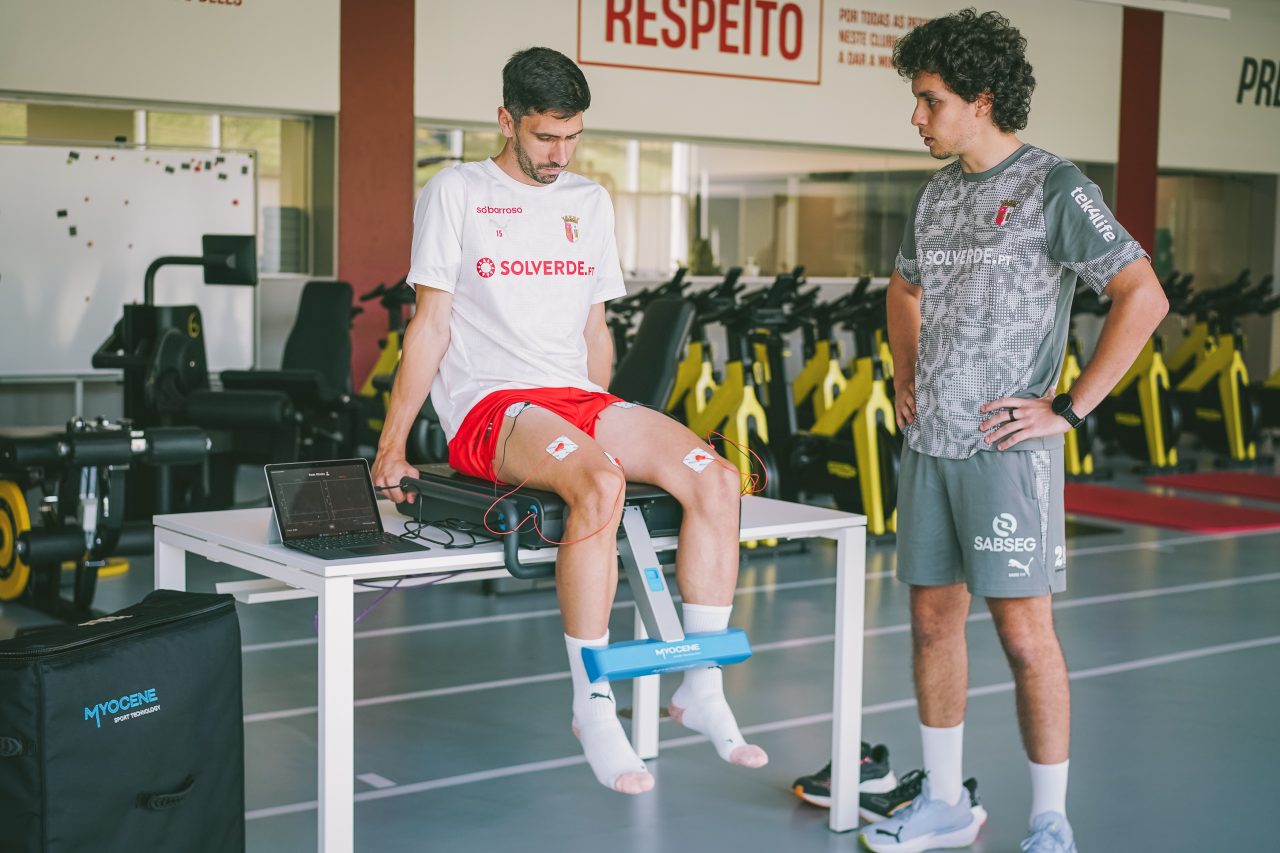
For the past few seasons SC Braga have been taking their performance monitoring to the next level with the integration of Myocene, a muscle fatigue assessment tool used to better understand player fatigue, optimize training loads, and support return-to-play decisions. The Myocene device is a game-changing tool in elite sport, providing objective, accurate, and quantifiable assessments of muscle fatigue in just 90 seconds. It allows practitioners to bring an athlete onto the device, connect the magnetic electrodes, and get a real-time fatigue index from both legs, fast, reliable, and ready to act on.
Measuring fatigue objectively is a necessity in modern football. Myocene provides us with reliable data to better manage fatigue and support more accurate decision-making – João Ribeiro (Head of Performance – SC Braga)
A Technology Already Trusted Worldwide
Low-frequency fatigue (LFF) has been recognized for decades as a key physiological marker influencing performance, recovery, and injury risk. Historically, its measurement required complex laboratory equipment, making practical on-field monitoring nearly impossible. That changed with the introduction of Myocene, first validated scientifically by Ridard et al. (2022). The technology opened the door to accurate, portable LFF assessment directly in real training and match environments, a capability rapidly adopted by leading clubs and performance departments around the world.
Book your demo HERE
Braga’s Use Reinforces Myocene’s Value for Elite sports teams
The club is applying the technology as part of their integrated performance strategy, using objective neuromuscular data to
- Track fatigue trends over time
- Individualize training loads
- Support informed return-to-play decisions
- Monitor readiness in congested competition schedules
The usage at the club further highlights exactly what Myocene was designed for: reliable, repeatable physiological insight on the field.
Consistent, Reliable Data
The latest independent publication by Maia et al. (2025) in Measurement in Physical Education and Exercise Science adds further confirmation to what elite practitioners like Braga experience daily. The study reports:
- Good to excellent test–retest reliability (ICC = 0.73–0.88)
- Very low measurement error (SEM = 1.1–1.9%)
- High reproducibility (MDC = 4–7%)
Elite performance environments make monitoring difficult as they have large squads, tight schedules, limited staff time, and constantly changing conditions due to travel and match demands. SC Braga’s use of Myocene shows how the device fits these constraints with fast, simple, and reliable testing that doesn’t disrupt training. The club uses Myocene to track fatigue, individualize loads, guide return-to-play, and monitor readiness during congested calendars. Their experience highlights Myocene’s core value, consistent, objective physiological insight delivered anywhere. These findings reinforce that Myocene continues to perform consistently under real-world, elite-level conditions.
Our findings show that Myocene delivers the level of reliability that high-performance environments demand. It’s fast, consistent, and brings a valid low-frequency fatigue monitoring instrument into real-world practice. – Filipe Maia
Myocene Data now Driving Decisions Every Day
Myocene stands as the unique reliable and field-ready solution for monitoring low-frequency fatigue in modern sport. The technology is being trusted, embedded, and acted upon by top clubs who need accurate muscular fatigue insights every week.
If you’re ready to see how Myocene can elevate your own performance monitoring, book your demo today.
References
- Maia F., Nakamura F.Y., Tito S., Ribeiro J. (2025). Test-Retest Reliability of Myocene for Assessing Lower Limb Low-Frequency Fatigue: A Cross-Condition Reliability Study. Measurement in Physical Education and Exercise Science.
- Ridard J., Rozand V., Millet G.Y., Lapole T. (2022). On-field low-frequency fatigue measurement after repeated drop jumps. Frontiers in Physiology.